
At the end of the day on Friday Adrienne and I met with the professor hematopathologist who is responsible for the conclusions of my brain biopsy specimen (they looked at these with a panel of experts).
She made time for us to talk about the outcomes of my brain biopsy specimen. It is not a standard practice that a pathologist explains their findings to a patient. So it was nice that the hematopathologist made time available to talk to us. The professor that we spoke to is experienced in ultra rare T-cell lymphoma. The first thing that she told us was that I was the most exceptional case that she saw in her entire career.
Like I said in my post of two days ago, the biopsy specimens of my brain showed massive amounts of oligoclonal T-cells. Strictly speaking, cancer would by monoclonal, healthy manifestations of T-cells are polyclonal (and do not appear like tumors). What I have is somewhere on this spectrum, leaning towards malignant disease and requiring treatment.
These “oligoclonal T-cell expansions in lymphoproliferative disorders” are ultra rare. They tend to appear more in immunocompromised patients (although they are also super rare in this group). For example AIDS patients, but also patients treated with immunosuppressive drugs, such as transplant patients or sometimes patients with serious autoimmune diseases, can be affected.
You can imagine why they point their finger at Fingolimod, the MS drug that I had been using, as a possible culprit. In cases where an immunosuppressive drug is thought to be the cause, the treatment choices are as follows: 1. Stop the immunosuppressant and see if the disease goes away 2. Reduce the lesion size with steroids and see if the lesions go away afterward 3. In the case of B-cell proliferation treat with a drug against B-cells (rituximab) 4. Use chemotherapy to try and eradicate the disease.
I am now at step four since steps one and two failed, and step three is not applicable because I have a T-cell and not a B-cell problem.
World wide 130.000 patients have been prescribed Gilenya (Fingolimod, the MS treatment), and a case like mine has never been reported. Also with other immunosuppressants, these kind of T-cell proliferations limited to the central nervous system have not been documented. Let’s hope that my unique disease reacts exceptionally well to the treatment.

 Four times they had to try to stick me with an infusion needle (needed to administer contrast agent during the scan). Luckily the second nurse that tried, after the first nurse had attempted three times, a second one managed to succeed in one try. Results of the scan will be communicated to me on the 20th of July.



 Back in February, I started this blog to keep my friends, colleagues, and family members up to date, without having to tell the same story over and over again. At the same time, writing down what was happening gave me the time to structure my thoughts and to process all the things that were going on. The only downside to continuing this blog is that people can be very interested in my situation, and can keep up to date with every detail without me knowing about it. When someone calls, visits, sends an email, card, or text message, I am instantly reminded that they care. Unfortunately, I can’t tell if someone obsessively reads my blog. I enabled ‘comments’ on my posts so that people could leave a note, but I understand that this is somewhat cumbersome (I enjoy reading them though).

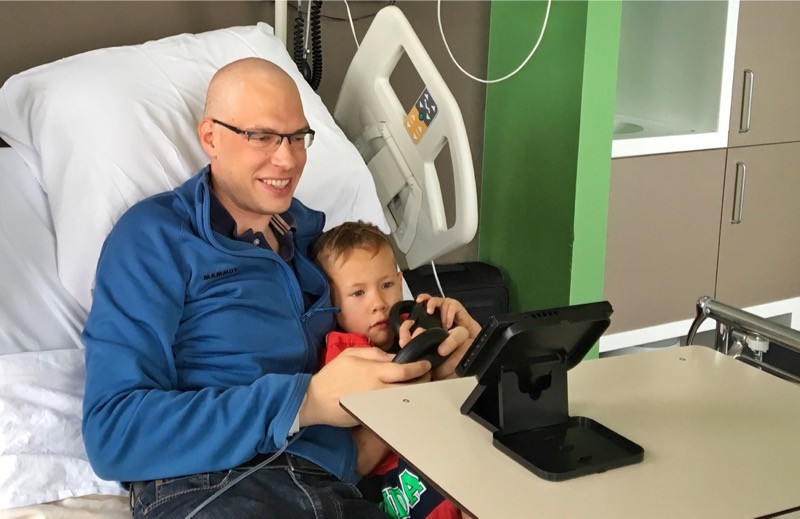
 The last course of methotrexate is running. This is the only chemo agent that remains of course two. Hopefully, the MRI of the 14th will show a positive effect of these two courses. If so then this is my last stay at the Jeroen Bosch hospital for the treatment and then the rest will be done at the VU. I will have to stay here until Friday or Saturday, depending on my blood level of methotrexate. As long as this is above a certain level they have to continue with hyperhydration and the administration of folic acid, a sort of antidote.
Recent Comments